The Petitioner's Tale — A Czech Republic Visa Novella
A novella in seven chapters: an Indian software engineer named K— petitions the Embassy of the Czech Republic, navigates a small Kafkaesque complication, and walks across the Charles Bridge. Bureaucratic fiction, working guide, April 2026.
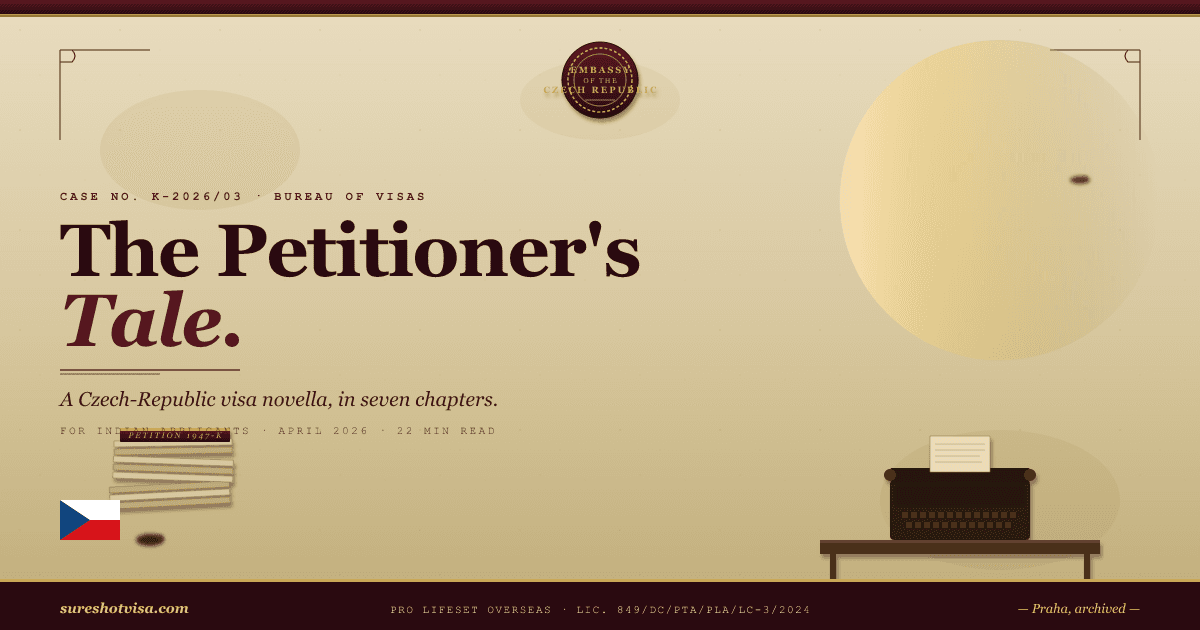
The Petitioner'sTale.
A Czech-Republic visa novella, in seven chapters — for Indian applicants who suspect the file has a soul of its own.
— A Brief Memo, Before We Begin —
To anyone who has ever applied for a Schengen visa and felt that the file was being read by no one and everyone at once: this is for you.
The Czech Republic does not, in fact, run a Kafkaesque visa system. It runs a perfectly ordinary one — fifteen calendar days, a fee in euros, a fingerprint, a stamp. But because the man who wrote The Trial wrote in this language, in this city, from this very bureaucracy, every Czech visa file deserves to be told as a small novella.
This one ends well. We promise.
FILED IN GOOD FAITHChapter I
In which the Petitioner is summoned by an idea.
The decision arrived without ceremony. K—, a thirty-one-year-old software engineer in Pune, was sitting in his second-floor flat in early April, drinking the last of his evening tea, when his sister forwarded him a photograph from a friend who was in Prague. The photograph showed a stone bridge in lamplight, with statues lined along it like sentries waiting for the next century to begin. K— stared at the photograph for some time. Then he closed it. Then he opened it again.
He put down the tea. He typed three words into the address bar: Czech visa India. By the time the kettle had cooled, he had read fourteen articles, opened six tabs at the VFS Global website, and become aware — in the way one becomes aware of a draft in a room — that he was now a Petitioner. He had not yet petitioned anything. But the decision had been made for him by the photograph, and the rest, as they say, was paperwork.
This is how every visa application begins. Not with research. With a photograph, or a wedding invitation from a cousin in Brno, or a music festival flyer for Colours of Ostrava, or simply the suspicion that there is a city somewhere in central Europe that you were always meant to walk through. The bureaucracy comes after. The bureaucracy is always after.
What the Petitioner did not yet know
He did not yet know that the Czech Embassy in New Delhi accepts applications only via VFS Global, that the Schengen visa fee is €90, that VFS will charge him roughly ₹1,500 in service fees on top, that fifteen calendar days is the standard processing time and that if he applied less than fifteen days before his flight, his file would be refused on principle alone. He did not know that the Embassy would want to see his bank statements for the last six months, his Income Tax Returns for the last three assessment years, his hotel bookings for every single night in Czechia, and a travel insurance policy with a minimum cover of €30,000.
He did not know any of this. He had only the photograph of the bridge. But this — this not-knowing — was the right and proper beginning. The Petitioner who knows everything before he begins has not begun. He has only research-typed himself into paralysis.
K— did the only sensible thing. He picked his travel dates first — the fifteenth of June through the twenty-eighth — and only then began to learn what he had committed to.
He was. The summons had come. The Petitioner does not unsummon himself.
"From a certain point onward there is no longer any turning back. That is the point that must be reached."— Franz Kafka, Pune adapt.
Chapter II
In which the file begins to speak.
By the second weekend, K— had gathered the documents. They sat on his dining table in three neat stacks. The stacks, if he was honest, frightened him a little — not because they were large, but because they had the air of things that have started to organise themselves without him.
The first stack was identity. His passport, valid until 2029, with two blank facing pages. Two photographs, 35 by 45 millimetres, white background, eighty per cent face — taken at a studio in Aundh that specialised in visa photography and refused to flatter him. (The studio man had said, looking at the result: "This is good. The Embassy wants you to look like yourself, not like someone else.") A copy of his Aadhaar. A copy of his PAN.
The second stack was finances. Bank statements for the previous six months, A4-sized, branch-stamped at his ICICI branch in Aundh, every page initialled by the manager in dark-blue ink. Income Tax Returns for assessment years 2023-24, 2024-25, 2025-26. Salary slips for the last three months. A no-objection letter from his employer, on official letterhead, stating that he was on approved leave from the fifteenth of June to the twenty-eighth, and that his salary would continue to be paid into the same account in his absence.
The third stack was the trip itself. A return flight reservation from Mumbai to Prague via Istanbul, held but not paid for. Hotel bookings, refundable, for each night of the journey: four nights in Prague, three in Český Krumlov, three in Brno, one final night back in Prague. A printed day-by-day itinerary. A travel insurance policy from Reliance with €30,000 cover and the words "valid in all Schengen states" visible on the first page. A motivation letter, written in formal English, three paragraphs, addressed: To the Visa Officer, Embassy of the Czech Republic.
The Petitioner's File — first inventory
- Passport (valid ≥ 3 mo past return, 2 blank pages)Original
- Visa application form, signed2 pp.
- Photographs, 35×45 mm, white bg, ICAO×2
- Cover / motivation letter1 page
- Bank statements, last 6 months, stampedBranch-stamped
- Income Tax Returns, 3 yearsITR-V
- Salary slips, last 3 monthsOriginals
- Employer NOC on letterheadOriginal
- Hotel bookings, every night, refundableBooking.com
- Return flight reservationHeld, not paid
- Day-by-day itinerary1 page
- Travel insurance, €30,000 minimum≈ ₹1,800
- Schengen visa fee, €90≈ ₹8,200
- VFS service charges≈ ₹1,500
The file, when assembled, weighed perhaps four hundred grams. K— picked it up and was surprised by how light it was. He had imagined that a Schengen visa file would weigh more — that something with the power to send him to Prague would feel commensurately heavy. But the file weighed almost nothing. The weight was in the meaning.
Chapter III
In which the Petitioner attends his biometrics.
The VFS Global office was in the basement of an office building near Lower Parel in Mumbai. K— arrived at 9:42 for his 10:00 appointment, having travelled by overnight bus, having eaten a vada pav at the station, having decided — and this was a small private rebellion — to wear a shirt with a collar instead of a t-shirt, on the grounds that the file would be assembled by someone in a shirt, and that some quiet correspondence between him and the file should be honoured.
The waiting area was air-conditioned to the temperature of a morgue. The walls were covered in posters of European destinations: a winter Vienna, an autumn Paris, a summer Greece. The poster of Prague was placed deliberately above the visa-submission counter for the Czech Republic, and K— spent some time staring at it. The Charles Bridge. The Astronomical Clock. A coffee on a square that he could not name. The poster's caption, in a sober font, read: The heart of Europe.
His number was called. He approached the counter. The clerk behind the glass was a woman of perhaps thirty-five who, by the time K— had sat down, had already inspected his file and found it to be — and this was clear from the faint nod she gave — adequate.
It took eleven minutes. Ten fingers were scanned in a soft blue light. A photograph was taken — a different photograph, taken on their camera, that K— had not been allowed to prepare for and that he was therefore certain came out wrong. The fee was paid. A pink receipt was placed in his hand. The pink receipt had a number. He was told to track the number on the VFS website.
By 10:43 he was outside, blinking in the white Mumbai sunlight, holding only the pink receipt and the realisation that — having spent six weeks gathering documents and, apparently, eleven minutes submitting them — the entire balance of the experience had now shifted away from him and into the file. The file was now in someone else's hands. K— was now the one waiting.
This is the precise moment, in any Schengen visa application, where the Petitioner becomes a passenger. There is nothing more to do. There is only the waiting.
"There is hope, infinite hope — but not for us."— except, of course, when there is.
Chapter IV
In which the Petitioner waits.
It is in the waiting that the Schengen visa reveals its character. The fee is paid. The biometrics are taken. The file has crossed the counter. And then — for fifteen calendar days, sometimes more, occasionally fewer — there is simply nothing.
K— refreshed the VFS tracking page approximately every forty minutes for the first three days. The page said the same thing each time: "Application received at the Embassy. Under process." He knew, intellectually, that the page would not change for at least a week. He refreshed it anyway. This is normal. This is the way the file claims a small, irrational corner of the Petitioner's mind and lives there until it is decided.
On day four he stopped checking and tried to live his life. He went to the office. He attended a wedding in Aurangabad. He read a book by Bohumil Hrabal because he thought, perhaps, that the act of reading a Czech writer would send a small private signal across the bureaucracy that he, K—, was a serious applicant. He understood that this was magical thinking. He read the book anyway. I Served the King of England. He liked it.
What the Embassy was doing
While K— was reading Hrabal, the Embassy of the Czech Republic in New Delhi was, in fact, doing the entirely ordinary work of any consular office. A junior officer was checking the file against a checklist. A senior officer was reviewing flagged cases. An automated system was running K—'s name against shared Schengen databases (SIS II, VIS) for any prior refusals or issues. None were found. K—'s travel history — three short trips to Bangkok, one to Singapore, all returned-on-time — was logged as a positive signal. His employment, his ITR, his bank balance (₹4.2 lakh, healthy for a 13-day Schengen trip): all logged. His insurance: verified. His hotels: spot-checked, by phone, for one of the four properties. The hotel confirmed the booking. The file moved forward.
None of this, of course, was visible to K—. To him, it was only the VFS tracking page, refusing to change.
What the Petitioner's file did, while he was reading Hrabal
- Day 0 — File received from VFS, logged into Embassy system+0
- Day 1–2 — Junior officer checklist verification+1d
- Day 2–3 — VIS / SIS II database screening+1d
- Day 3–5 — Senior officer review, hotel spot-check+2d
- Day 5–10 — File queued for decisionqueue
- Day 10–12 — Decision made, approved, visa printeddecided
- Day 12–14 — Passport returned to VFS by courierin transit
- Day 14–15 — Petitioner notified, passport collected+15d
The waiting, as is so often the case, was the least dignified part of the entire process. K— was a competent professional, capable of running the deployment of a forty-thousand-line codebase, capable of negotiating his salary, capable of explaining to his mother why he was thirty-one and unmarried. And yet for two weeks he was reduced to refreshing a webpage that would not refresh.
This too is part of the visa. Take it lightly. Refresh once a day. Read your Hrabal.
Chapter V
In which a small complication arises.
On day eleven, the VFS page changed. K— had stopped refreshing it by then, but his sister — who had been refreshing it on his behalf, possibly more often than him — phoned him.
K— sat down on the sofa.
The Embassy had emailed him directly. The email was polite, in the careful English that all consular offices share. They had two questions. First: would he kindly provide a printed-and-signed copy of his hotel booking for the three nights in Brno, as the version submitted appeared to be a screenshot rather than a confirmation email. Second: would he kindly clarify the nature of a single deposit of ₹1.85 lakh that had appeared in his bank statement on the twentieth of February, six weeks before he had begun his application.
The first question was easy. K— logged into Booking.com, downloaded the original confirmation email, printed it, signed it, and scanned it. Done in eleven minutes.
The second question required him to think. The deposit was a Diwali bonus from his employer, paid in February because the company had had a strong fourth quarter and had distributed bonuses late. He had a bank statement that already showed the deposit, but the source was not labelled. So he wrote a short letter:
— K—'s Reply, in Two Paragraphs —
To the Visa Officer, with regards. The deposit of ₹1,85,000 on 20 February 2026 is a discretionary annual performance bonus, paid by my employer (Acme Software Pvt. Ltd., Pune) for the financial year 2024-25. The company's quarterly results were distributed in February rather than December owing to the audit cycle.
I attach: (a) the letter from my HR department dated 18 February 2026 confirming the bonus and the amount; (b) the corresponding payslip for February 2026 showing the bonus line; (c) the relevant page of my bank statement with the deposit highlighted and matched to the payslip. I trust this clarifies the source of funds.
He uploaded the reply via the VFS portal. He pressed submit. He held his breath in the way that all Petitioners hold their breath when a complication has been introduced into a file. He let the breath go.
What the complication actually meant
The Embassy was not suspicious of K—. The Embassy was being thorough. A single large deposit in the months before a Schengen application is a routine flag — the kind of thing consular officers are trained to ask about, partly because it sometimes signals a file that has been topped up to look richer than the applicant truly is, and partly because asking is simply due diligence. K—'s deposit had a clean, documentable source. He provided it. The flag closed.
This is the great Schengen secret that every Indian Petitioner should engrave on a small bronze plaque and hang on his wall: a query is not a refusal. An additional documents request is the Embassy doing you the courtesy of asking before deciding, rather than refusing on a technicality. If you receive one — and roughly one in five Indian applicants will — answer it the same day, with the document, in clear English, with respect.
K— answered his on the same day. The portal updated within four hours. The status returned to: Under process. The complication was filed. The story moved forward.
Chapter VI
In which the file returns.
It came on the fourteenth day, in the early afternoon, by SMS. K— was in a meeting at the office, his phone face-down on the conference table. The phone vibrated. He turned it over, glanced down, and read:
The message did not say granted. It did not say refused. It said only that the passport was ready. This is, by design, how VFS communicates: the news is delivered when you open the envelope, not before.
K— made his apologies in the meeting, took an early lunch, and ordered a cab to Lower Parel. The driver, who had been told the address, asked: Visa office, sir? K— said: yes. The driver said: Best of luck, sir. K— sat in the back, holding his pink receipt, and tried to make himself feel nothing.
At the VFS office, he handed over the pink receipt. A different clerk from the first one — younger, more cheerful — looked it up, walked into a back room, and returned with a small sealed envelope. The envelope had K—'s name on it, and a barcode, and the words Passport — Czech Republic.
K— signed for it. He stepped outside. He stood on the pavement in the heat. He opened the envelope.
His passport was inside. Folded inside the passport was a single A4 sheet — the visa decision letter. He unfolded it. He read the first line. He read the second line. He sat down on a low wall.
The visa was a Schengen Type C, multiple entry, valid from 10 June 2026 to 10 December 2026, for a maximum stay of 30 days. It was stamped on page 17 of his passport. The stamp had a holographic strip that caught the Mumbai light. K— stared at it for a long time.
He did not, in that moment, feel triumphant. He felt — and this surprised him — slightly empty, in the way one feels slightly empty after finishing a good novel. Six weeks of work. Two weeks of waiting. One small complication. And now, on a low wall outside a basement office in Lower Parel, an unimpressive sticker on page 17 that gave him the right to walk across the Charles Bridge.
He took a photograph of it, because that is what one does. He sent the photograph to his sister. She replied within a minute: OMG. OMG. OMG. He stood up. He walked to the cab stand. He went home.
Chapter VII (the last)
In which the Petitioner arrives.
The flight was at 04:25 from Mumbai. K—'s mother insisted on driving him to the airport. She did not, by long-standing family agreement, ever drive at 02:00 in the morning, and yet she did this once, for her son's first trip to Europe, and they did not speak much in the car except that she said, somewhere near the airport, Make sure you eat properly.
The flight was nine and a half hours to Istanbul, then three more to Prague. He slept through the first one. He could not sleep through the second. He watched, through the small oval window, central Europe unfold in green and grey patches under a thin layer of cloud — the Carpathians, then the Slovakian plains, then the long descent towards Vaclav Havel International Airport.
At passport control, the queue for non-EU passports was forty-five people deep. K— stood in it for nineteen minutes. When his turn came, the officer — a young man in his late twenties, in a dark blue uniform — took the passport, opened it to the visa page, scanned the barcode, looked up, and said:
The stamp went down with a small, definitive sound. K— received his passport back. He walked through baggage claim, through customs, out into a cool June morning that smelled, faintly, of tram electricity and bread.
This is how the Petitioner's tale ends. Not with a fanfare. Not with a great revelation. With an ordinary man, walking out of an ordinary airport, into an ordinary morning, in a city he had been told all his life he could not visit, holding a passport that now contained — on page 17, with a small holographic strip — the official acknowledgement that he could.
The bridge from his sister's photograph was three days away. The statues were waiting. The Petitioner was here.
The moral of the novella
If there is one, it is this: the Czech Republic is not Kafka. The Czech Republic is the country that survived Kafka — that produced him, and outlived him, and emerged on the other side of the twentieth century with a working visa system and a willingness to grant it to a thirty-one-year-old software engineer from Pune who simply asks correctly.
Apply at least four weeks before your flight. Submit a clean file. Answer queries the same day they arrive. Wait without refreshing, or refresh and forgive yourself for refreshing. If you do these four things, your novella will end exactly the way K—'s ended: with a stamp, a welcome, and a cool morning that smells of bread.
— A Letter from the Bureau —
If your file feels heavier than it should,
let us help you carry it.
SureshotVisa is a Government of Punjab licensed visa consultancy (License 849/DC/PTA/PLA/LC-3/2024). We have filed Czech Schengen applications since 2018. Free first consultation. Pay only on success.
Begin Your Petition Read the Czech Visa Page— Sureshotvisa.com · A brand of Pro Lifeset Overseas Pvt. Ltd. · Patiala, Punjab —
Need Help with Your Visa Application?
Our experts handle everything — documents, VFS slots, embassy filing.
We answer within 5 minutes · No obligation
Full Country Guide
Czech Republic Visa from India — fees, documents, processing time
Everything you need on one page: VFS centres, visa types, fee breakdown, doc checklist.
Related Guides
The Austria Visa — A Symphony in Four Movements
From Allegro to Finale: the Austria Schengen visa scored as a classical symphony for Indian travellers. Four movements, fifteen days, one visa stamp, and the train to Vienna leaving in thirty.
Read guide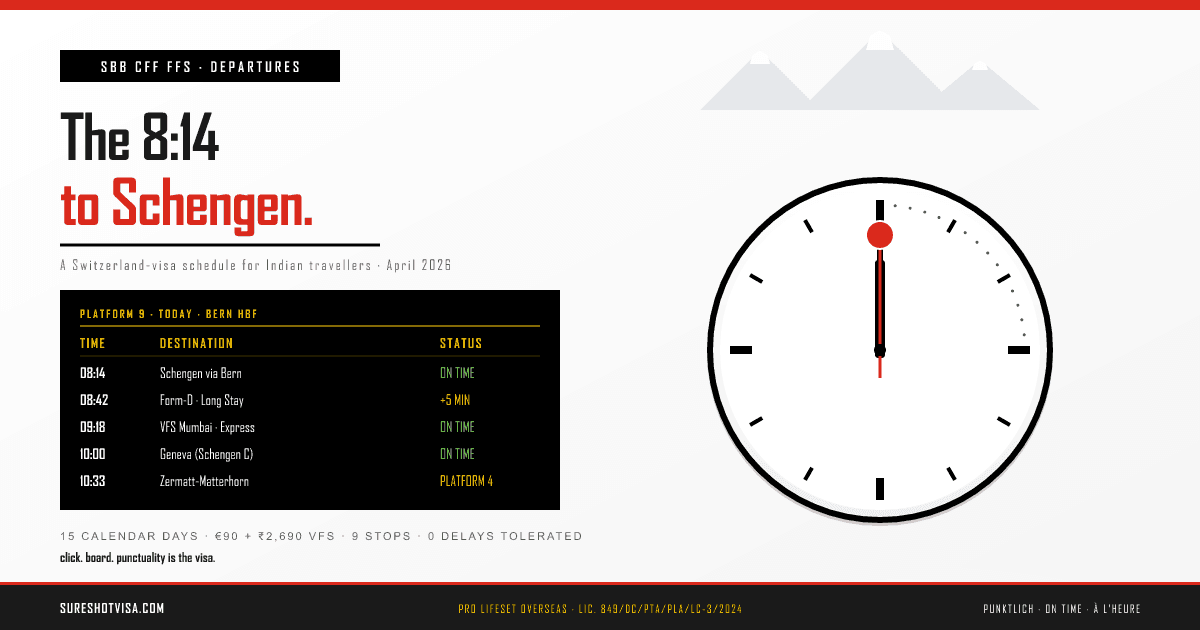
The 8:14 to Schengen — A Switzerland Visa Timetable
The Swiss visa runs on a Hans Hilfiker clock. A railway-timetable guide to Switzerland's Schengen visa from India — every platform, every fee, every minute that matters. Punctuality is the visa.
Read guide
Bulgaria Visa, Slow-Fermented. A Yogurt-Maker's Guide.
Bulgaria runs on slow time — yogurt cultures, rose harvests, fifteen-day visa cycles. A grandmother's-pace memoir of getting the Bulgaria visa from India in 2026, with recipes, wisdom, and a diary of the wait.
Read guide
The Denmark Visa — Lego Instructions for Adults
Fourteen numbered steps, a parts list, and the satisfying click of a finished file. The Denmark Schengen visa from India, assembled like the Lego set it secretly is. April 2026.
Read guide