The Italy Visa, Served as a Seven-Course Feast
Twenty-one Italian visa categories, plated as a Tuscan banquet — antipasti through dolce. A food-memoir guide to filing your Italy Schengen from India in 2026, with recipes for paperwork and a wine list of mistakes to avoid.
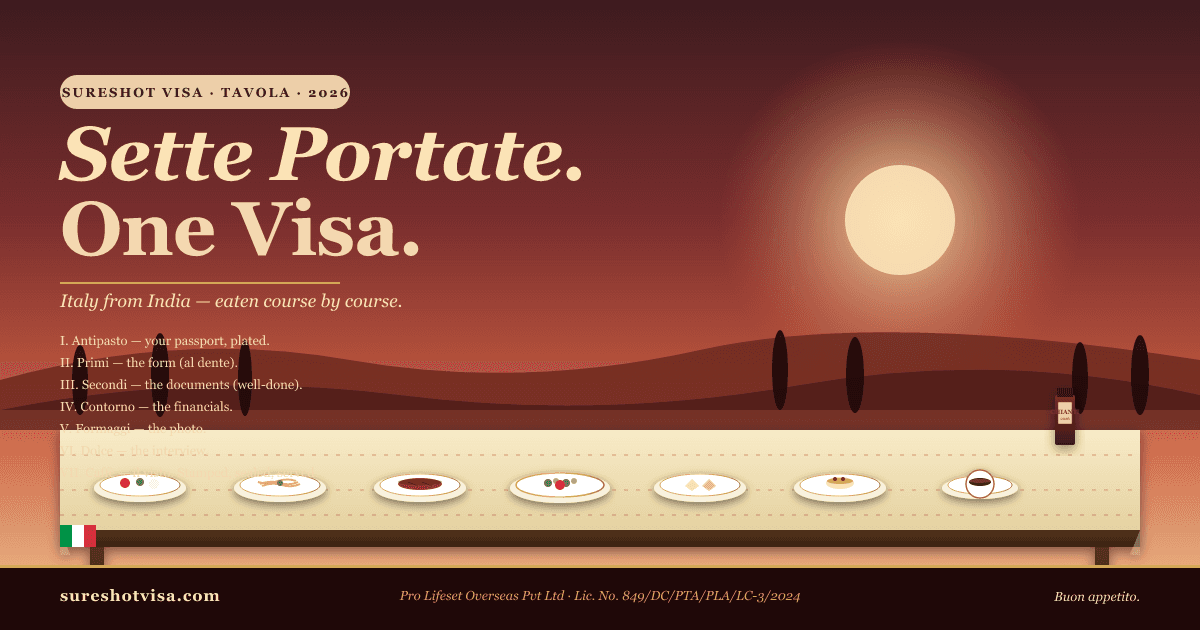
Sette portate.
One Italian visa.
The Italy visa from India — served the way the Italians serve everything else: in seven courses, no hurrying.
Aperitivo0.Before we sit down
In Italy, nobody starts a meal in a hurry. You come in. You sit. The waiter doesn't appear immediately, and that is the point. He appears when you are ready, not before. The menu does not change in a panic. The bread is on the table because of course it is.
So we are going to do this the Italian way. Not because we are romantic, but because the Italian visa actually rewards patience. Every Indian who has applied for an Italian Schengen visa knows this: the worst applications are the ones submitted in a panic. The best ones — the ones that come back stamped and silent and without a word from the embassy — were prepared the way a good nonna prepares Sunday lunch. Slowly. With pride. With everything in its proper place.
This guide is the table. The seven plates that follow are the courses. By the end, you will know exactly what an Italy visa from India tastes like — what it costs, what it requires, where it is hard, and where it is easier than people pretend.
Pour yourself a small glass of something. Let's begin.
You set the table for it.
Primo PiattoI.Antipasto — your passport, plated
Every Italian meal begins with antipasto. Small things. Olives, prosciutto, a few slices of bread. None of it is the main event. All of it is essential, because antipasto is what tells the kitchen who has arrived and what kind of night this is going to be. The visa officer does the same thing with your passport. Before he reads a single word of your file, he opens the passport and looks at the first ten seconds.
What he sees in those ten seconds
He flips to the data page. He looks at how worn the cover is. He counts blank pages. He looks at the date the passport was issued. He looks at the country stamps you have collected — Thailand, Sri Lanka, Dubai, Singapore — and from these, before any document, he is already deciding whether to like you.
This is unfair. It is also human, and it is how visas have always been read. Your job in this course is to make the antipasto good.
The passport, prepared
- Issued within the last 10 years (machine-readable; no handwritten observations made after 2010)
- Valid at least 3 months past your return date
- At least 2 blank pages back-to-back for the visa sticker
- If your passport has a "previously known as" entry — bring proof: old passport, MEA letter, or the gazette / newspaper name-change advertisement
- Photocopies of all previous passports showing entries to UAE, Thailand, Singapore, Sri Lanka — anything Schengen-respected as proof you came back
Italians have a phrase: la prima impressione si fa una volta sola. The first impression is made only once. Spend an evening on this course before any other.
Secondo PiattoII.Primi — the form (al dente)
Italians do not negotiate with pasta. There is exactly one correct way to cook it: al dente, with a tiny bite remaining at the centre. Soft pasta is an insult. Hard pasta is a failure. The form your visa application sits on — the Schengen Type C application form — is exactly the same. It must be cooked precisely. Not a question undercooked. Not a field overstated. Al dente.
Filling the form like a Roman housewife folds tortellini
Most Indian applications are rejected — quietly, without the embassy ever asking — because the form is sloppy. Lazy capitalisation. Wrong passport number digit. The "purpose of visit" written in two contradictory ways. A blank field that should have said not applicable instead of being left empty.
The form is the only thing in your file that the visa officer is required to read. Everything else is supporting evidence. So write it the way an Italian grandmother makes pasta: every fold the same, every edge clean, every line sealed.
The Schengen Type C application — Italy
- Where to downloadVFS Italy India
- LanguageEnglish (block letters)
- PagesLast 6 (do not skip)
- Signed inTwo places (form + declaration)
- Photo to be attached35 × 45 mm, ICAO
One detail Indians get wrong over and over: question 21 ("Member State(s) of destination") and question 22 ("Member State of first entry") are not the same. If you fly Air India direct to Rome and then catch a train to Paris, your destination is France (most days spent), but your first entry is Italy. The form punishes you if you confuse them.
Cook the pasta carefully. Drain it. Plate it. Move on.
Terzo PiattoIII.Secondi — the documents (well-done)
A Tuscan steak is a serious thing. It is thick. It is rare in the middle, charred outside, served on a plate that has been warmed for it. You eat it slowly, with red wine, and you do not talk for a few minutes. The documents tab in your visa file is the same: heavy, sober, deserving of respect.
The list
Italians have a saying: se ti manca un ingrediente, non cucinare. If an ingredient is missing, do not cook. Do not submit a half-prepared file. The Italian Embassy does not ask for missing documents. It refuses, and asks you to come back. Each return trip costs you ₹11,000 in re-applied fees plus the time. Better to wait two extra weeks and submit complete.
What every Italian short-stay file contains
- Cover letter — one page in plain English, written by you (not your travel agent), explaining who you are, where you are going, what you will do, when you will return. Sign it.
- Travel itinerary — flights (round-trip, reservation only — do not ticket until visa is approved), hotels for every night, internal travel between cities
- Travel medical insurance — €30,000 minimum cover, valid across all 29 Schengen states, covering medical emergency + repatriation, on the right form (the Italian embassy publishes a list of approved insurers)
- Hotel bookings — confirmed in your name, refundable booking acceptable, for every single night of the stay (no gaps)
- Forex / cash declaration — Form A2 from your bank, ideally with the foreign-currency bought, dated within the last 30 days
- Employment proof — NOC from your employer on letterhead, salary slips for last 3 months, copy of company registration / GST
- If self-employed — GST registration, MSME / Udyam certificate, last 2 years' company ITR + 6 months' company bank statement
- Tax — last 3 years' personal ITR-V (income tax acknowledgement)
One of the things the Italians look for that not every Schengen country emphasises is internal travel proof. If you are visiting Rome, Florence, and Venice in 9 days, they want to see the train tickets between those cities — not just the international flights. They are checking whether your story holds together as a story. A real traveller has a real plan. A fake traveller has only a Rome hotel and a return ticket.
Quarto PiattoIV.Contorno — the financials
The contorno is what comes alongside the meat. A fennel salad. Spinach in olive oil. Roasted potatoes with rosemary. Italians never eat meat alone — there must be something green or something earthy on the side, because that is how the body and the meal stay balanced. Your financials are the contorno. The visa officer does not believe a stand-alone bank balance any more than an Italian believes in a steak with no vegetable.
What "showing money" actually means
Every Indian applicant is told they need to "show funds". Most of them interpret this as a single dramatic act: deposit ₹3 lakh into the savings account a week before submission. This is the worst thing you can do. Visa officers are professional pattern-readers. They are looking for one specific thing — organic balance. A bank account that has lived a normal life for the last six months. Salary credits in. Rent debits out. Some Swiggy. Some petrol. Some weekend shopping at D-Mart. A real life that quietly grew its balance to a sensible number.
A sudden ₹3 lakh deposit is not money — it is a stage prop. Officers see it for what it is in three seconds.
What sits next to the steak
- Bank statement windowLast 6 months
- Closing balance comfort range₹1–1.5 lakh per traveller per week of trip
- Statement formatOriginal, A4, bank-stamped + signed
- ITR + Form 16Last 3 assessment years
- FD + investment statementsWelcome, not required
- Cash injection in last 30 daysAvoid
The amount that "looks comfortable" depends on your duration. A week in Italy reasonably costs ₹1–1.2 lakh per person all-in. The embassy is not asking you to be rich. It is asking you to look like the kind of traveller who has saved up for the trip — not the kind who borrowed money the week before.
A bad cover letter says: I deposited ₹3 lakh last week.
Quinto PiattoV.Formaggi — the photo
In a proper Italian dinner, the cheese course comes after the main and before the dessert. It is small. It is curated. There is usually parmesan, something soft, something blue. It is the kind of thing that looks simple and is impossible to get wrong only if you know what you are doing. Your visa photograph is exactly that: small, simple, impossible to get wrong only if you know the rules.
Italian VFS rejects more applications for bad photos than for bad bank statements. Most Indians do not believe this until it happens to them.
The Italian Schengen photo, in detail
- 35 mm × 45 mm, no borders, no white margin
- Full colour, plain white background — not cream, not light grey, not pale blue
- Face takes up 70–80% of the photograph (chin to top of hair = 30–36 mm)
- Looking directly at the camera, neutral expression, mouth closed
- No glasses if possible. If you must, no tinted lenses, no thick frames, no glare
- No headgear unless religious — and even then, the full face from chin to forehead must be visible
- Taken within the last 6 months
- Printed on photographic paper. Not inkjet. Not laser. Photographic.
The Italian VFS gets exact about a detail nobody else does: the shoulders. Both shoulders must be visible and roughly horizontal. If you tilt your head, or if the photographer crops too close, the photo is rejected. The reasoning is biometric — the officer needs to verify face geometry, and a tilted face throws the geometry off.
If you take the photo at a corner Photo Studio, ask for "Schengen Italy spec — 35 by 45, white background, ICAO-compliant, full shoulders." Do not let them argue with you. If they argue, walk to a different shop.
Sesto PiattoVI.Dolce — the interview (rare, but real)
Most diners do not order dessert. The waiter does not insist. The dolce comes if you ask for it, or if the chef is in a generous mood and decides you deserve a small panna cotta on the house. The interview at the Italian embassy is exactly this. Most applicants do not get one. Some — the ones whose file does not quite add up, or whose cover letter contradicts their itinerary — are called in. It is not a punishment. It is a chance to clear up a doubt.
Who gets called in
- First-time international travellers applying directly to a tier-1 country with no Asian travel history
- Self-employed applicants whose declared income does not match their declared trip cost
- Applicants with a previous Schengen / UK / US refusal that they have declared honestly (good — the interview is your chance to explain)
- Applicants visiting unusual destinations — small towns instead of Rome, or extended stays in regions tourists rarely go
The interview is short. 5 to 15 minutes. The officer wants three things: to confirm your story, to confirm your funds, and to confirm your return.
If you are called in, here is what to bring
Yourself, alone (no agent, no relative). The full original file in a folder. Photocopies of everything in case the embassy keeps an original. Calm. Genuine answers. The truth. The Italian Embassy can spot a coached applicant in two questions; do not be coached.
One small Italian detail: officers often ask not "where are you going" but "what will you eat in Italy." It sounds like a casual question. It is a check — a real traveller has read about ribollita or arancini or trofie al pesto. A fake one has not.
Settimo PiattoVII.Caffè — il visto. Stamped. Sealed. Served.
A real Italian dinner does not end with the dessert. It ends with caffè — a single shot of espresso, sweet, dark, taken standing if you must. The caffè is what tells you the meal is over. Not the bill. Not the goodbye. The caffè. Your visa journey ends with the same small ritual: collecting your passport from VFS, opening it on the metro home, finding the new sticker, and quietly saying finito.
What the sticker actually says
The Schengen visa sticker has a few key fields. Read them carefully on the day you collect:
- Valid from / valid until — the window in which you can travel
- Duration of stay — total days you can spend across all 29 Schengen states inside that window
- Number of entries — 1 (single), 2 (double), or MULT (multiple)
- Issued at — usually NEW DELHI or MUMBAI
- Type — C (short-stay) or D (long-stay; rare)
If the sticker says "C / 90 / MULT / valid 1 year" — congratulations. You have a one-year multiple-entry Schengen, with up to 90 days of stay inside any rolling 180-day window. This is the second-best gift the Italian embassy gives an Indian. (The best gift is the long-validity Schengen, but those are rare and earned with travel history.)
The fee, plated and itemised
What the seven courses cost
- Schengen visa fee (adult)€90 ≈ ₹8,500
- Schengen visa fee (child 6–12)€45 ≈ ₹4,250
- VFS service charge~₹1,800
- SMS service (optional)~₹420
- Premium Lounge (optional)~₹3,500
- Courier passport return (optional)~₹700
- Realistic total per adult~₹11,000
Compare this to the trip itself — flights to Rome are ₹50–70k round-trip, a week of hotels and food and trains is ₹70k–1L per person — and the visa is the cheapest part of going to Italy. The expensive part is making the hotel reservations and then getting it right.
It is the menu.
DopocenaAfter Dinner — some honest things
Three things every Indian applicant should hear honestly, the way a good oste tells you the truth about his cellar.
1. Italy is one of the easier Schengens — but only for clean files
Italy has a reputation among Indian travellers for being more forgiving than Germany or Switzerland. This is roughly true. The Italian VFS in India is well-staffed, processing times are honest (usually 10–15 working days, sometimes 8), and the Italian Embassy is not in the habit of refusing without reason. But this only works if your file is clean. A messy file gets refused in Italy as cleanly as it does in Germany. The reputation is for clean files.
2. Bank balance is not the limiting factor
Indians overestimate bank balance and underestimate cover letter. A ₹2 lakh balance with a strong cover letter, real itinerary, and visible employment will beat a ₹10 lakh balance with a vague itinerary and a generic cover letter. The visa officer is not looking for the richest Indian — he is looking for the most credible one.
3. The hotel reservation matters more than people say
Italians take seriously the idea that a real traveller has chosen a real place to stay. A $30 hostel in a nowhere neighbourhood looks suspicious for a 35-year-old IT manager. A €120/night central Rome hotel looks suspicious for a self-employed shop owner whose ITR shows ₹4 lakh declared income. Match the hotel to the income. This single principle decides more cases than any other.
4. Refusals have a 90-day reapply window — but use it well
Italy does not impose a mandatory cooling-off after a refusal. You can reapply the next morning. You should not. The next application must address — directly, on the cover letter — what was wrong with the previous one. If the refusal was 32(1)(b) (intent to return), your next file needs more weight on India ties: property, dependents, an employer letter that names dates. If 32(1)(c) (purpose of visit), your next itinerary needs to be specific: museum tickets, day-trip bookings, named restaurants. Do not reapply with the same file.
If you want help setting the table
SureshotVisa is the online brand of Pro Lifeset Overseas Pvt Ltd — a Government-of-Punjab licensed immigration consultancy (Lic. No. 849/DC/PTA/PLA/LC-3/2024). We have walked Indian families through the Italian Schengen, course by course, since 2024. The first call is free and the truth is also free.
📞 Call us — +91 98149-25703 Book consultation →— Buon appetito, e buon viaggio —
Need Help with Your Visa Application?
Our experts handle everything — documents, VFS slots, embassy filing.
We answer within 5 minutes · No obligation
Full Country Guide
Italy Visa from India — fees, documents, processing time
Everything you need on one page: VFS centres, visa types, fee breakdown, doc checklist.
Related Guides
The Petitioner's Tale — A Czech Republic Visa Novella
A novella in seven chapters: an Indian software engineer named K— petitions the Embassy of the Czech Republic, navigates a small Kafkaesque complication, and walks across the Charles Bridge. Bureaucratic fiction, working guide, April 2026.
Read guide
The Austria Visa — A Symphony in Four Movements
From Allegro to Finale: the Austria Schengen visa scored as a classical symphony for Indian travellers. Four movements, fifteen days, one visa stamp, and the train to Vienna leaving in thirty.
Read guide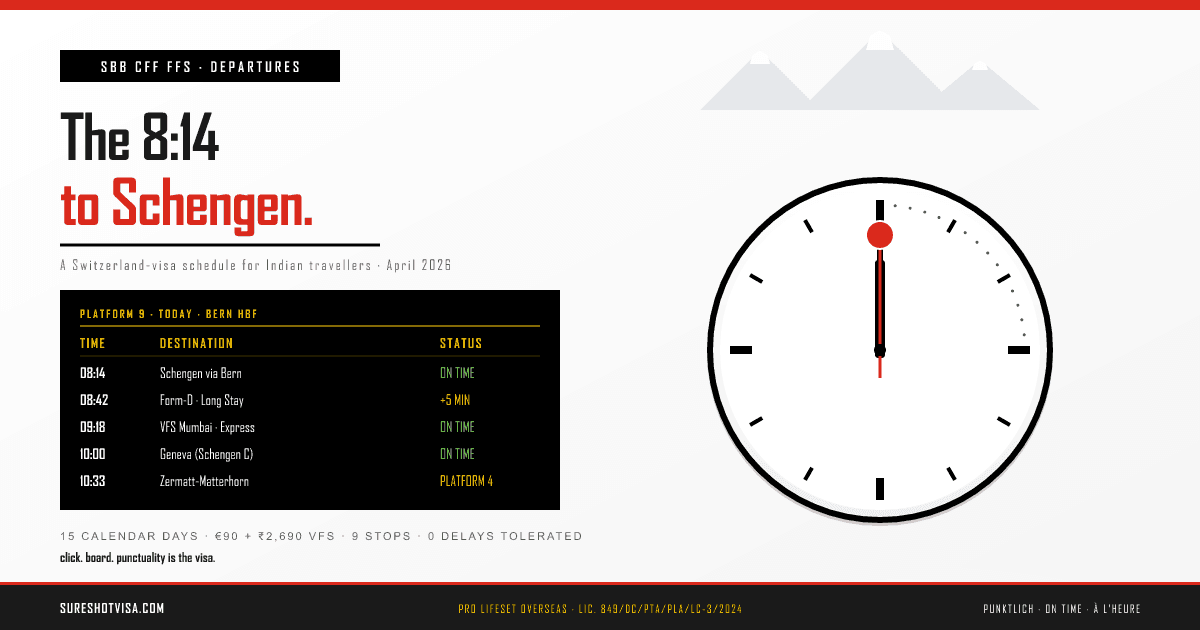
The 8:14 to Schengen — A Switzerland Visa Timetable
The Swiss visa runs on a Hans Hilfiker clock. A railway-timetable guide to Switzerland's Schengen visa from India — every platform, every fee, every minute that matters. Punctuality is the visa.
Read guide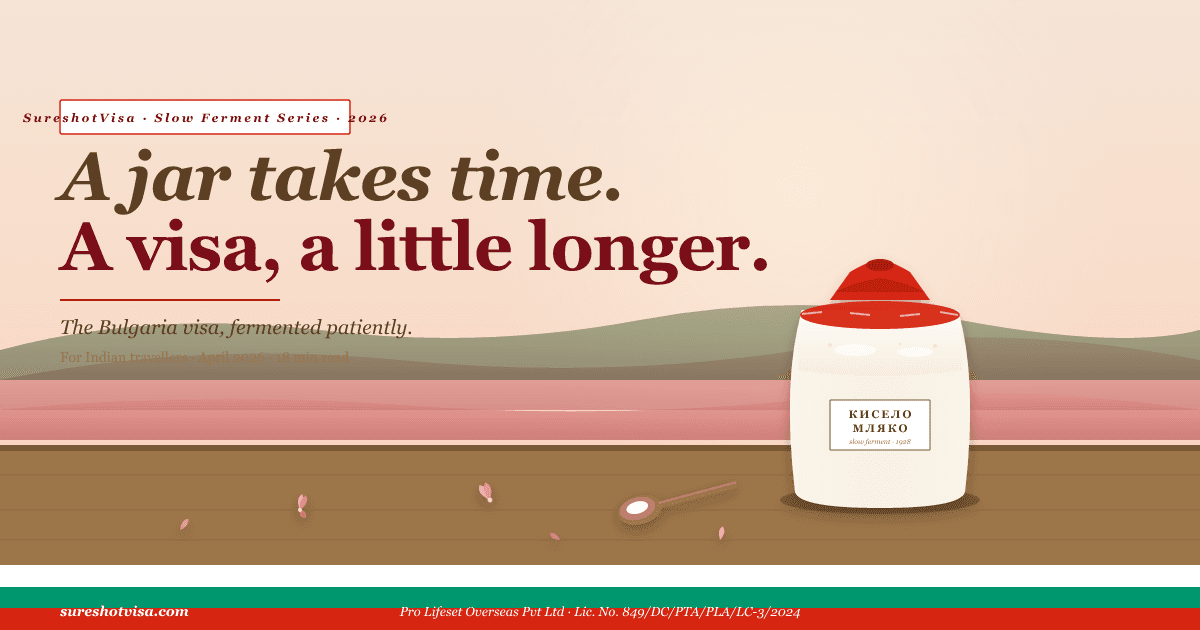
Bulgaria Visa, Slow-Fermented. A Yogurt-Maker's Guide.
Bulgaria runs on slow time — yogurt cultures, rose harvests, fifteen-day visa cycles. A grandmother's-pace memoir of getting the Bulgaria visa from India in 2026, with recipes, wisdom, and a diary of the wait.
Read guide